Credible Law Announces Holiday Cash-Flow Relief Resource for Businesses Facing MCA Debt
New educational initiative helps small business owners evaluate merchant cash advance repayment pressure, and explore
Press Release Disclaimer: This is a press release distributed through the XPR Media network. It has not been independently verified by our newsroom.
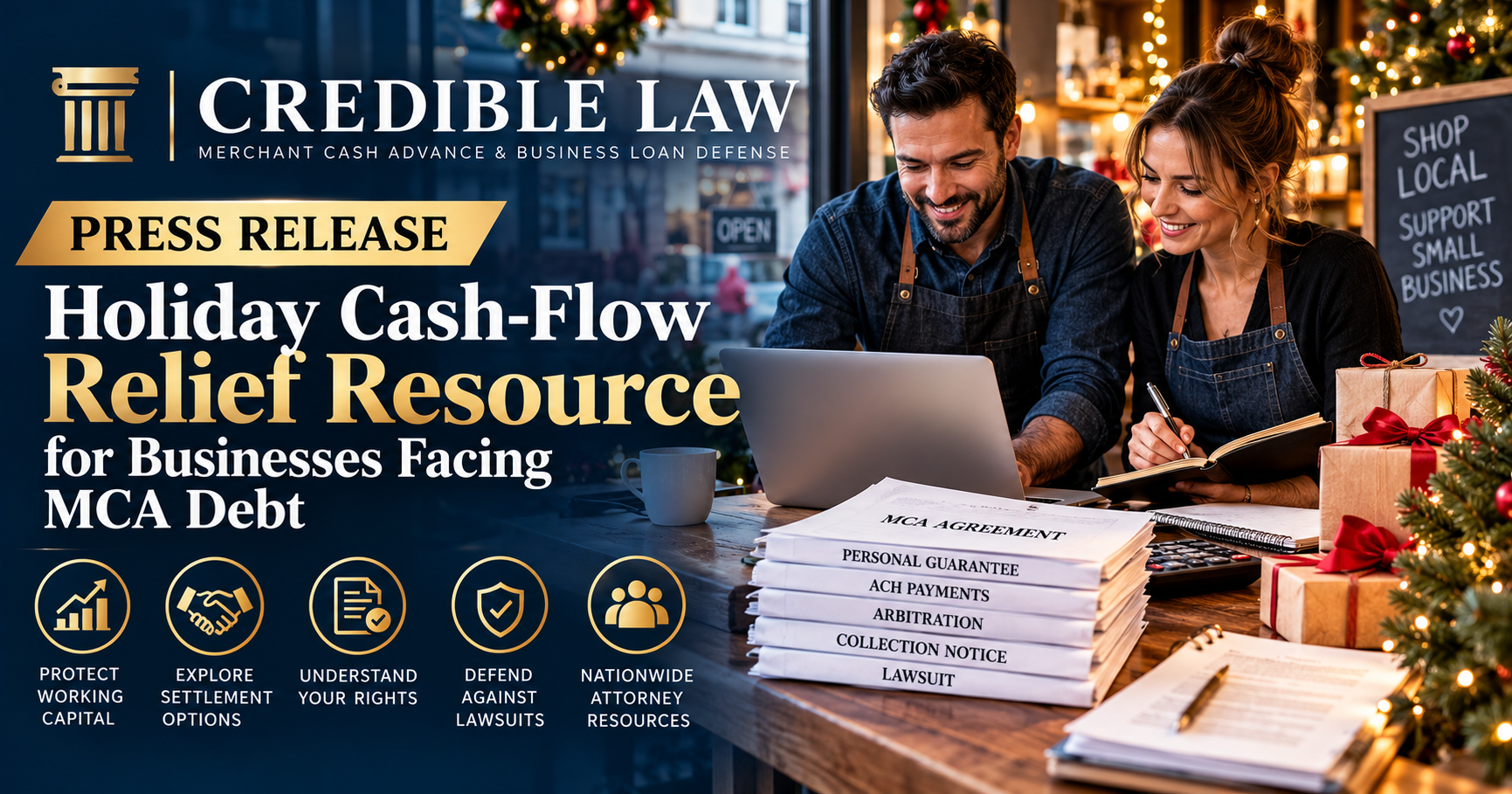

New educational initiative helps small business owners evaluate merchant cash advance repayment pressure, and explore potential debt settlement options.
SAN DIEGO, CA, UNITED STATES, October 27, 2026 /EINPresswire.com/ — Credible Law, a legal information and attorney referral resource serving business owners nationwide, is introducing its Holiday Cash-Flow Relief Resource to help small businesses better understand merchant cash advance (MCA) obligations, evaluate potential legal and financial options, and prepare for the added operating expenses associated with the upcoming holiday season.
The initiative focuses on a challenge facing businesses that rely on short-term commercial financing: maintaining sufficient working capital for payroll, inventory, supplier payments, rent, and daily operations while making frequent payments under merchant cash advance agreements.
For retailers, restaurants, contractors, transportation companies, and other businesses, the weeks leading into Thanksgiving, Black Friday, Small Business Saturday, and the December holidays can require substantial advance spending. Businesses may need to purchase inventory, hire seasonal employees, extend operating hours, or invest in marketing before the resulting revenue is collected.
When a company is also managing one or more merchant cash advance agreements, the timing of those obligations can become especially important.
Credible Law’s new educational initiative encourages owners to review their financing agreements, understand their contractual rights, and evaluate available options before repayment difficulties develop into collection actions, arbitration proceedings, or lawsuits.
The resource complements Credible Law’s existing information about merchant cash advance attorneys and MCA lawsuit defense, including contract disputes, reconciliation provisions, personal guarantees, settlement negotiations, and legal considerations for businesses facing aggressive collection activity.
Holiday Spending Optimism Meets Persistent Small Business Cash-Flow Challenges
The initiative arrives as recent economic surveys present a mixed picture of the 2026 holiday shopping season.
According to the Intuit QuickBooks 2026 Holiday Shopping Survey, 76% of surveyed small business owners and decision-makers expect to generate more revenue during this year’s holiday season than they did in 2025. The survey also projects approximately $118 billion in holiday spending at small businesses, reflecting continued consumer interest in supporting independent merchants.
At the same time, stronger sales expectations do not necessarily eliminate financial pressure.
Main Street America’s Fall 2026 Small Business Survey, which gathered responses from 1,568 small business owners across the United States and its territories, identified maintaining positive cash flow, attracting customers, and managing inventory at sustainable costs among the challenges businesses continue to face.
These findings highlight an important distinction between revenue growth and financial flexibility.
A business can experience increased customer demand while still struggling to maintain the cash necessary to support daily operations. Seasonal inventory purchases, employee wages, supplier invoices, insurance premiums, and other expenses may become payable before customers complete their purchases.
For businesses using merchant cash advances, the structure of repayment obligations can add another layer of complexity.
Unlike conventional installment loans, some merchant cash advance agreements involve the purchase of a specified amount of future receivables, with remittances tied to revenue under the contract’s terms. Other arrangements involve fixed daily or weekly withdrawals, sometimes subject to reconciliation provisions.
The precise legal treatment of an agreement depends on its language, operation, and applicable law.
Credible Law’s holiday initiative is designed to help business owners identify these differences and understand why contract terms matter when revenue fluctuates.
How Merchant Cash Advance Payments Can Affect Holiday Working Capital
Merchant cash advances are frequently used by businesses seeking relatively quick access to funding. Depending on the provider and transaction, financing may be used for inventory purchases, equipment, marketing, operational expenses, or other business needs.
However, repayment arrangements can create difficulties when sales decline, expenses rise, or multiple financing obligations overlap.
Consider a hypothetical small business with three merchant cash advance agreements requiring combined withdrawals of $1,200 per business day.
Over a 20-business-day period, those payments would total approximately $24,000.
That amount could otherwise be available for inventory, employee compensation, supplier payments, or other expenses, depending on the business’s financial circumstances.
This example is illustrative, not a representation of any particular Credible Law client or a typical MCA repayment amount.
The central issue is not simply how much revenue a business generates, but how much cash remains available after operating expenses and contractual payment obligations.
A business experiencing strong holiday demand may still encounter financial strain if substantial withdrawals occur before it receives payment from customers or converts purchased inventory into sales.
Multiple MCA agreements can further complicate financial planning.
When businesses obtain additional advances while existing obligations remain outstanding, the combined payment schedule may reduce flexibility and make it harder to respond to unexpected expenses.
Credible Law encourages business owners to examine their total payment obligations rather than evaluating each financing agreement in isolation.
Understanding the combined effect of repayment schedules can help owners determine whether they should seek professional financial guidance, request contract reconciliation, discuss potential modifications, or consult an attorney regarding a financing dispute.
Five Areas Covered by Credible Law’s Holiday Cash-Flow Relief Resource
The Holiday Cash-Flow Relief Resource provides a framework for evaluating merchant cash advance obligations before the busiest weeks of the year.
1. Reviewing Daily and Weekly MCA Withdrawals
The first step is developing an accurate picture of existing financing obligations.
Business owners should identify every active merchant cash advance agreement, the remaining purchased receivables or contractual balance, the payment frequency, and the accounts from which withdrawals occur.
Owners should also distinguish between fixed withdrawals and remittances that vary with actual receivables.
A clear repayment schedule can help businesses evaluate the cash needed for essential operating expenses and identify potential shortfalls before they become emergencies.
2. Understanding Merchant Cash Advance Reconciliation Rights
Some MCA agreements contain reconciliation provisions allowing payment amounts to be adjusted based on changes in business revenue.
Whether reconciliation is available, how it must be requested, and what documentation is required depend on the specific agreement.
A reconciliation provision does not automatically guarantee reduced payments.
Nevertheless, businesses experiencing declining receipts may benefit from having qualified counsel review whether the contract provides an enforceable adjustment mechanism and whether the funder has complied with its obligations.
Owners should preserve relevant sales reports, bank statements, payment records, and communications with financing companies.
3. Evaluating Settlement and Repayment Modification Options
Businesses facing repayment difficulties may be able to discuss negotiated settlements, modified payment schedules, or other arrangements with creditors.
Possible outcomes depend on the creditor, contractual terms, financial circumstances, and legal posture of the dispute.
Credible Law’s resource explains why business owners should assess the total cost and consequences of any proposed arrangement, including whether personal guarantees remain enforceable and whether a settlement provides an appropriate written release.
Businesses should avoid assuming that a verbal agreement or partial payment automatically resolves an outstanding obligation.
4. Identifying Lawsuit, Arbitration, and Collection Risks
Merchant cash advance disputes may involve collection demands, arbitration proceedings, court filings, or attempts to enforce judgments.
Ignoring these communications can create additional legal exposure.
Businesses receiving a summons, arbitration demand, or notice concerning a bank account restraint should promptly determine the applicable response deadlines and seek advice from appropriately licensed legal counsel.
The availability of defenses depends on the facts, governing law, and procedural requirements.
The holiday season does not automatically suspend court deadlines or contractual obligations.
5. Protecting Essential Business Operations
Credible Law also encourages owners to evaluate how financing obligations affect payroll, supplier relationships, inventory purchases, tax responsibilities, and other essential expenses.
A realistic short-term cash-flow forecast can help businesses identify when funds will be received, when obligations become payable, and where financial pressure may arise.
The goal is to help owners make informed decisions while considering their contractual responsibilities and available legal options.
No particular financing strategy or settlement outcome is appropriate for every business.
New York MCA Lenders and Out-of-State Business Owners
Merchant cash advance disputes are not always confined to the state where a business operates.
A business located in California, Florida, Texas, Illinois, or another state may have entered into a financing agreement with a company based in New York.
Depending on the agreement and surrounding circumstances, disputes may involve New York choice-of-law provisions, forum-selection clauses, arbitration requirements, personal guarantees, or attempts to enforce judgments across state lines.
These issues can be especially confusing for owners who have never operated a business in New York but receive legal documents connected to a New York financing company.
Credible Law’s New York MCA defense attorney resources address issues such as merchant cash advance lawsuits, contract disputes, jurisdictional questions, arbitration proceedings, and creditor enforcement actions.
Business owners should not assume that a lender’s New York address automatically determines where a lawsuit must proceed or which legal defenses are available.
Likewise, the existence of a personal guarantee does not establish the outcome of a dispute without considering the agreement and applicable law.
When legal action has already begun, timely review of the relevant documents is particularly important.
California Businesses Face Their Own Financing and Collection Considerations
California businesses may encounter many of the same repayment challenges while operating under a different legal and regulatory framework.
Retailers, restaurants, hospitality businesses, contractors, transportation operators, and professional service providers often have varying revenue cycles and operating expenses.
For some businesses, seasonal demand can produce substantial revenue increases. Others may experience slower collections, higher staffing expenses, or increased supplier costs.
California also has commercial financing disclosure requirements that may apply to certain transactions, depending on the financing product, provider, transaction amount, and other statutory conditions.
Those requirements should not be confused with a blanket prohibition on merchant cash advances or an automatic right to cancel an agreement.
Credible Law’s California MCA defense attorney resources provide information for businesses evaluating merchant cash advance disputes, repayment obligations, collection actions, and potential legal defenses.
The resource is relevant to businesses in Los Angeles, San Diego, Riverside, Orange County, San Francisco, Sacramento, San Jose, and communities throughout California.
For California businesses dealing with out-of-state financing companies, legal analysis may also involve questions concerning governing law, jurisdiction, arbitration, and judgment enforcement.
Credible Law encourages owners to obtain qualified advice before making decisions that could affect their contractual or legal obligations.
Reducing Financial Stress Begins With Understanding Available Options
Financial pressure can affect more than a business’s balance sheet.
Owners responsible for employee wages, supplier relationships, customer service, and ongoing operations may face difficult decisions when available cash is insufficient to cover competing obligations.
The holiday season can intensify these concerns because business owners may feel pressure to invest in additional inventory or staffing while simultaneously managing existing debt.
Credible Law’s initiative emphasizes preparation, accurate documentation, and early evaluation of financing agreements.
Business owners do not necessarily need to wait until a lawsuit is filed to understand their contractual rights or seek professional guidance.
Reviewing repayment obligations before a potential default may provide additional time to evaluate the business’s financial position and determine whether discussions with financing companies are appropriate.
At the same time, business owners should be cautious of services promising guaranteed debt elimination, immediate cancellation of financing agreements, or automatic protection from creditor collection actions.
Merchant cash advance disputes are fact-specific, and legal outcomes cannot be guaranteed.
The resource encourages owners to ask practical questions: What does the agreement require? Are payments tied to actual revenue? Does the contract contain a reconciliation provision? Are there personal guarantees? Has a creditor issued a formal legal notice? What documentation is available to support the business’s financial circumstances?
Answering those questions can provide a more reliable foundation for decision-making.
A Year-End Opportunity to Review Business Financing Obligations
Although the holiday shopping season is the immediate focus, the initiative also addresses the importance of reviewing business financing arrangements before the end of the calendar year.
Owners preparing annual financial statements, evaluating profitability, or developing budgets for 2027 may benefit from a complete inventory of outstanding financing obligations.
This review can include the original amount advanced, contractual repayment amount, payments already made, outstanding obligations, disputed charges, and any pending legal proceedings.
Businesses should also consider consulting accounting or tax professionals regarding the financial reporting and tax treatment of their transactions.
For owners facing multiple MCA agreements, reviewing the entire debt structure may reveal cash-flow concerns that are difficult to recognize when each payment is considered separately.
Credible Law’s educational approach focuses on helping business owners identify relevant questions, organize their records, and understand when specialized legal assistance may be necessary.
The initiative does not recommend that businesses unilaterally stop payments or disregard contractual obligations.
Instead, it encourages informed evaluation of available options under the governing agreements and applicable law.
Helping Small Businesses Prepare for the 2026 Holiday Season
The 2026 holiday season presents both opportunities and financial challenges for American small businesses.
Consumer interest in shopping locally and supporting independent merchants may create opportunities for increased revenue, but realizing those opportunities often requires sufficient working capital to maintain inventory, employees, and operations.
For businesses managing merchant cash advance debt, understanding the relationship between financing obligations and operating cash flow is an important part of that preparation.
Credible Law’s Holiday Cash-Flow Relief Resource is intended to make information about MCA repayment structures, reconciliation provisions, debt settlement considerations, and legal disputes more accessible to business owners.
The broader objective is to encourage earlier financial planning and informed legal decision-making, rather than waiting for payment difficulties to escalate into more serious disputes.
Business owners seeking information about merchant cash advance agreements, MCA lawsuits, debt settlement considerations, or commercial financing disputes can contact Credible Law at (888) 201-0441.
About Credible Law
Credible Law is a legal information and attorney referral resource providing educational content about merchant cash advances, business financing disputes, commercial debt collection, lawsuits, personal guarantees, and related legal matters.
Through its online resources, Credible Law helps business owners better understand financing agreements, identify potential legal issues, and explore appropriate avenues for professional assistance.
Credible Law provides information for businesses throughout the United States, including those facing disputes involving out-of-state merchant cash advance lenders.
Information provided through Credible Law is educational and does not constitute legal advice. The availability of attorney assistance and potential legal remedies depends on the circumstances of each matter and applicable professional requirements.
Kevin Leonard
Credible Law
+ +1-888-201-0441
contact@crediblelaw.com
Visit us on social media:
LinkedIn
Facebook
YouTube
Other
Legal Disclaimer:
EIN Presswire provides this news content “as is” without warranty of any kind. We do not accept any responsibility or liability
for the accuracy, content, images, videos, licenses, completeness, legality, or reliability of the information contained in this
article. If you have any complaints or copyright issues related to this article, kindly contact the author above.

Media gallery