Baseball Pitching Coach Jim Rembach Applies Pitching Mechanics to Corporate Execution in The Drift Tax
The Drift Tax, an Amazon Best Seller in two business and management categories, uses pitching's kinetic chain to
Press Release Disclaimer: This is a press release distributed through the XPR Media network. It has not been independently verified by our newsroom.
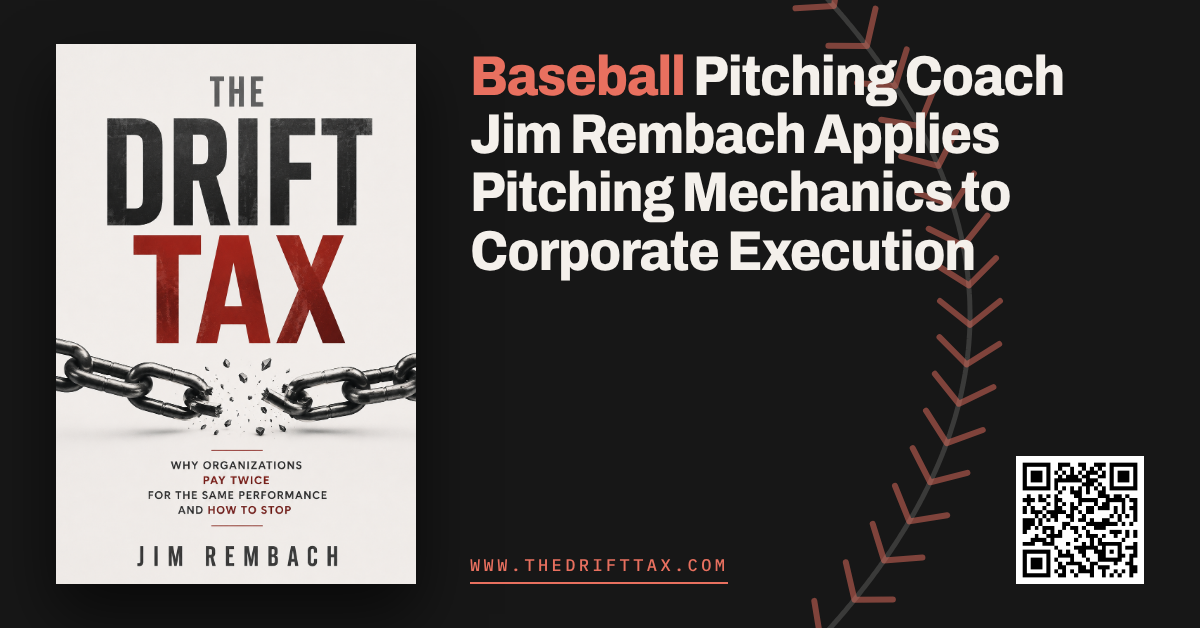

The Drift Tax, an Amazon Best Seller in two business and management categories, uses pitching’s kinetic chain to examine how strategy reaches frontline work.
GREENSBORO, NC, UNITED STATES, October 22, 2026 /EINPresswire.com/ — Jim Rembach, a certified baseball pitching coach and Executive Director of the Leadership Execution Institute, applies the mechanics of pitching to corporate execution in his book The Drift Tax: Why Organizations Pay Twice for the Same Performance and How to Stop. The book, published by LEI Press on October 12, 2026, is an Amazon Best Seller in two business and management categories. It cites research showing that about 70 percent of change initiatives fail and that as many as 95 percent of enterprise AI pilots do not deliver scalable business impact.
The book’s central comparison comes from the pitcher’s mound, and its publication coincides with the professional baseball championship, which millions of fans will follow this week.
How does the book connect pitching to business?
The book opens with a principle from pitching biomechanics. “A 95-mile-per-hour fastball does not come from the arm,” Rembach writes. “The arm is the last link in a highly coordinated mechanical movement pattern.” In his account, force starts in the ground and travels through the legs, hips, and torso before it reaches the hand. When the sequence works, each link amplifies the one before it. When a link fires out of order, the pitcher compensates with the arm.
The concept traces to orthopedic surgeon Arthur Steindler, who described human movement as an interconnected system in which motion at one segment affects what happens throughout the kinetic chain.
Rembach applies the same model to organizations and calls it the Kinetic Chain of Execution: the sequence through which strategic intent becomes actual behavior and, eventually, a result that generates velocity and momentum. “Strategy is the legs. Structure is the hips. Management is the torso,” he writes. “And the frontline, where an actual human does an actual thing a customer actually experiences, is the arm.”
What does the book say happens when the sequence breaks?
“Executives keep trying to throw harder with the arm, placing more pressure on the last link,” Rembach writes. In pitching, he notes, that added load increases injury risk to the shoulder or elbow. The book argues that organizations show a similar pattern: pressure increases on frontline teams while the loss of momentum occurs earlier, in the transfers between strategy, structure, and management.
What is the Drift Tax?
The book defines the Drift Tax as the cumulative cost organizations absorb when behavioral stability decays after investment, forcing the same performance to be paid for again. According to the book, the cost is recorded in separate places rather than as a single line: as margin compression in finance, productivity variance in operations, turnover in human resources, and delayed timelines in strategy.
“Jim has named the most expensive line item missing from every P&L, and the costly decisions based on that information,” said James K. Weeks, Ph.D., Dean Emeritus and Professor Emeritus of the Bryan School of Business and Economics at UNC Greensboro. “He explains how execution failure stems from the erosion of systems and standards and the Kinetic Chain of Execution, even for great teams.”
What are the implications for investors and corporations?
Rembach notes that when a company pays again for performance it has already funded, through consultants, coaching, program relaunches, or replacement hiring, the expense is typically recorded as operating expense. That places the cost inside EBITDA, a measure that private equity firms track across a holding period and that venture capital investors watch as portfolio companies scale. For large corporations, he says, the cost recurs across divisions and budget cycles.
He also points to a contrast with professional baseball, where teams track pitch counts to manage the workload on pitchers they have invested in. Corporate financial statements, he says, do not include a comparable line showing whether performance a company has paid for is still being delivered.
What is the author’s background?
Rembach has coached pitchers since he was twenty-two. He has had six shoulder surgeries, beginning at nineteen with a torn rotator cuff, and writes that for decades he did not know why. In 2020 he completed the SAVAGE Pitching Coaches Certification, which he pursued when his son began throwing hard at age twelve. He writes that the training taught him that movement does not change through information alone, and that each pitcher needs an assessment and a personalized development plan that are revisited over time. His business career spans three decades in complex operations, including the contact center industry. He is the host of the Fast Leader Show.
Availability
The Drift Tax is available in hardcover, paperback, ebook, and audiobook through Amazon and major retailers. The book includes the Drift Tax Diagnostic, a ten-statement assessment that produces an Architecture Score, which is also available at no cost at www.thedrifttax.com. Excerpts and details are at www.thedrifttax.com.
About The Drift Tax
The Drift Tax: Why Organizations Pay Twice for the Same Performance and How to Stop, by Jim Rembach, is published by LEI Press and was released October 12, 2026, in hardcover (ISBN 979-8-90589-141-0), paperback (ISBN 979-8-90589-140-3), ebook (ISBN 979-8-90589-139-7), and audiobook (ISBN 979-8-90589-142-7). It is about the hidden taxes organizations pay when their people drift, causing execution failures, and how to stop paying them. www.thedrifttax.com
About Jim Rembach
Jim Rembach is the Executive Director of the Leadership Execution Institute and President of Execution Architects, where he helps organizations design and implement the scaffolding needed to upgrade their operating systems for the post-AI era. He is the author of The Drift Tax and the host of the Fast Leader Show, where he has interviewed hundreds of the world’s most influential management thinkers. He spent three decades inside complex operations before writing the book. He lives in Greensboro, North Carolina.
About LEI Press and the Leadership Execution Institute
LEI Press is the publishing division of the Leadership Execution Institute, an independent research organization studying leadership behavior, behavioral drift, and culture-calibrated execution systems in modern organizations. The institute’s research briefs, reports, and publications are available at leadershipexecutioninstitute.org.
Review copies and interviews are available on request.
Emma Allen
Leadership Execution Institute
+1 336-202-1032
press@leadershipexecutioninstitute.org
Visit us on social media:
LinkedIn
YouTube
Legal Disclaimer:
EIN Presswire provides this news content “as is” without warranty of any kind. We do not accept any responsibility or liability
for the accuracy, content, images, videos, licenses, completeness, legality, or reliability of the information contained in this
article. If you have any complaints or copyright issues related to this article, kindly contact the author above.

Media gallery