What Makes an All-in-One Smart Gym Different from Traditional Fitness Equipment
HONG KONG, HONG KONG, CHINA, September 21, 2026 /EINPresswire.com/ -- A digital resistance system looks simple from the
Press Release Disclaimer: This is a press release distributed through the XPR Media network. It has not been independently verified by our newsroom.

HONG KONG, HONG KONG, CHINA, September 21, 2026 /EINPresswire.com/ — A digital resistance system looks simple from the outside—a compact panel, a set of handles, and a cable—but the engineering inside determines whether it delivers a training experience comparable to traditional gym equipment. The core components—a servo motor, a real-time control system, and software that governs how resistance behaves—work together to create a training platform that adapts to the user in ways that fixed weights cannot. Understanding this engineering reveals why the difference between an all-in-one smart gym and traditional equipment goes beyond surface-level features.
The engineering behind digital resistance has been developed through years of research and validated through independent testing. Based on the technology behind Innodigym’s product line—supported by 84 patents and verified through surface EMG muscle activation studies—the following four areas explain what makes an all-in-one smart gym fundamentally different from traditional fitness equipment:
Servo motor precision vs gravity-based resistance — how the motor generates load electronically and adjusts it within each repetition, compared to the fixed load of a weight stack.
Resistance curve design for targeted muscle development — how different resistance profiles target different training outcomes, from constant load to eccentric overload and isokinetic control.
sEMG-validated training stimulus — what independent muscle activation studies reveal about whether digital resistance delivers the same neuromuscular demand as traditional weights.
Mechanical durability and reliability engineering — how the system is tested for long-term use, including cycle tests, cable tension verification, and structural load validation.
Servo Motor Precision vs Gravity-Based Resistance
Traditional gym equipment relies on gravity. Weight plates and selectorized stacks provide a fixed load that does not adapt to the user’s strength curve. The resistance is the same at every point in the movement, regardless of whether that matches the user’s mechanical advantage at each joint angle. An all-in-one smart gym uses a servo motor to generate resistance electronically, and the quality of that resistance depends on the motor type and control system. Innodigym’s P1 series uses a PMSM 5.0 servo motor that automatically lowers the load when muscle failure is reached, helping you safely complete your full training set. The OMNI X1 PRO uses a high-torque servo motor that delivers up to 264 pounds of resistance with the same real-time adjustment capability. This means the load follows the user’s strength output at every point in the movement, rather than delivering the same force regardless of position—a fundamental difference in how resistance is delivered.
Resistance Curve Design and Muscle Development
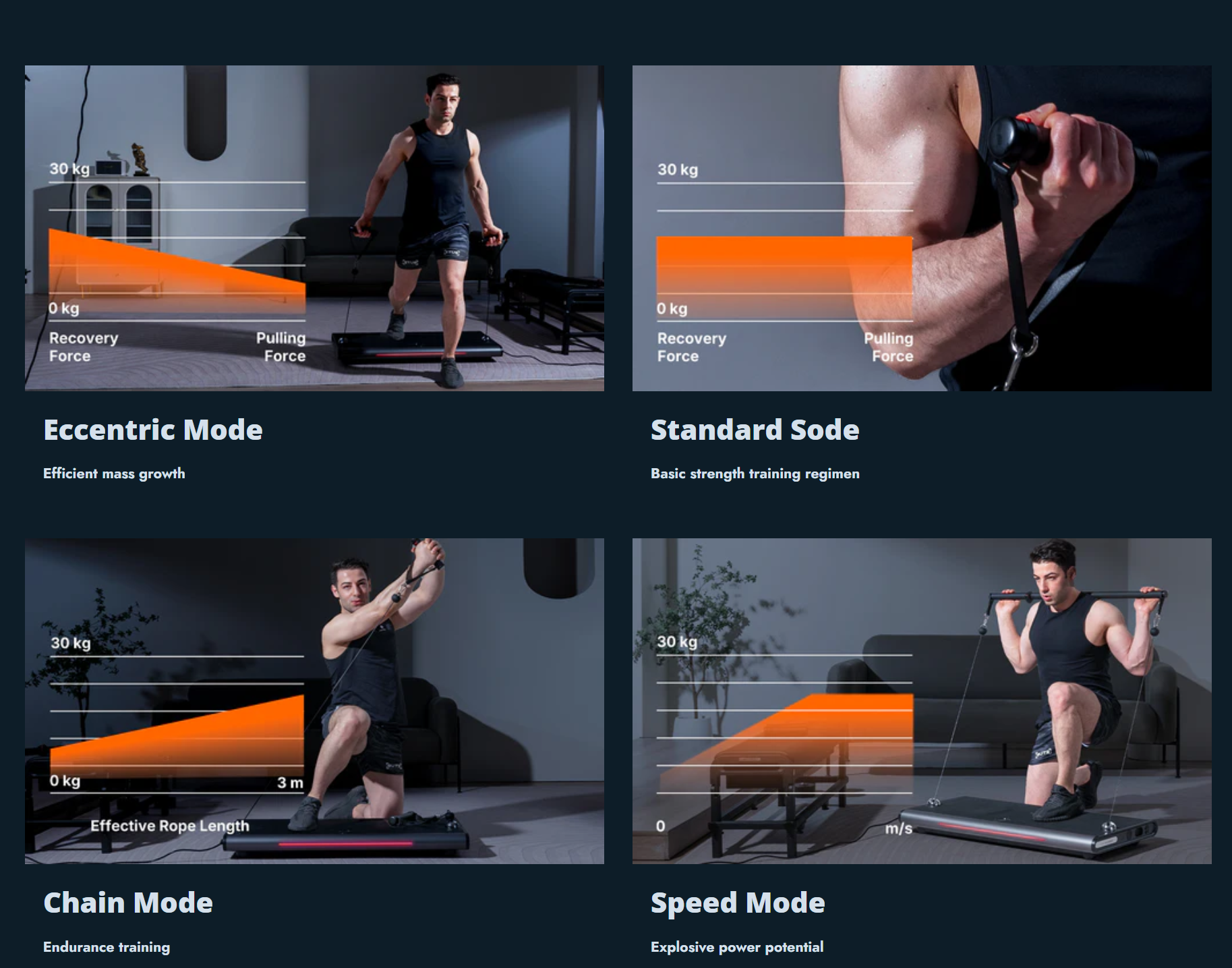
Muscle fibers respond differently depending on how the load is applied. Constant tension recruits both slow-twitch and fast-twitch fibers. Increased load during the eccentric phase creates a hypertrophy stimulus that research has shown to be particularly effective for muscle growth. Explosive, variable resistance targets power development. Isokinetic resistance, which maintains constant speed regardless of force, supports endurance and rehabilitation. Digital resistance systems can switch between these profiles because the motor’s behavior is controlled by software, not by mechanical changes. Innodigym’s P1 series delivers four resistance modes—standard, eccentric, chain, and speed—with chain mode progressively increasing resistance as the user extends. Building on this foundation, the OMNI X1 PRO introduces an upgraded set of profiles: standard, eccentric, spring, and isokinetic. Spring mode simulates the accommodating resistance of elastic bands for explosive power work, while isokinetic mode maintains a constant velocity ideal for rehabilitation and muscular endurance. This range of resistance profiles allows a single system to replace the function of a cable tower, a set of elastic bands, and a traditional weight stack—without requiring physical changes between modes.
sEMG Validation: Independent Scientific Evidence
Surface electromyography (sEMG) measures the electrical activity produced by skeletal muscles during contraction—higher readings indicate greater motor unit recruitment. In a controlled study comparing the OMNI X1 PRO to conventional gym equipment, the same subject performed identical exercises on both systems under standardized conditions. The results revealed measurable differences in how each system activated target muscles. During bench press, the OMNI X1 PRO achieved higher pectoral activation (34.8% vs. 31.4% MVC) while engaging the triceps significantly less (5.7% vs. 11.3% MVC), suggesting a more isolated chest stimulus. The most pronounced advantage appeared in the lat pulldown, where the OMNI X1 PRO showed higher activation across all major back-related muscle groups—latissimus dorsi, posterior deltoid, middle trapezius, and biceps—indicating stronger overall back engagement. Cable crunch also favored the OMNI X1 PRO, with both higher average (13.8% vs. 8.3% MVC) and peak (33.3% vs. 19.8% MVC) rectus abdominis activation. In arm isolation exercises such as the triceps pushdown and biceps curl, activation levels were nearly identical to traditional equipment. These findings suggest that digital resistance can match or improve upon traditional equipment in exercises where target muscle engagement is often compromised, while retaining familiar resistance feel. Detailed study results and methodology are available on the Innodigym product research page.
Mechanical Durability and Reliability Engineering
A traditional weight stack has few moving parts and is mechanically simple. A digital resistance system includes a motor, cable mechanism, sensors, and electronics that must all function reliably over years of use. Innodigym’s OMNI X1 PRO has undergone a 250,000-cycle durability test simulating over ten years of regular use based on three to five training sessions per week. The cable system has been separately tested to withstand 132 pounds of sustained tension without deformation or failure. The assisted pull-up footplate has been tested to support users up to 220 pounds. These tests establish safety margins for the mechanical components and provide documented evidence of long-term reliability. The system is backed by a standard warranty and ongoing software updates that continue to add capabilities.
The engineering difference between a basic motorized cable and a precision digital resistance system comes down to three factors: motor type, control software, and validation data. A basic motor applies fixed resistance. A precision servo motor with real-time feedback adjusts continuously. The control software determines what resistance profiles are available. And independent validation data confirms whether the system delivers the training stimulus it claims. Innodigym addresses all three with PMSM servo motors, four distinct training modes, and sEMG-validated performance data that confirms the training stimulus matches or exceeds traditional weights.
Servo motor precision, resistance curve design, sEMG-validated performance, and mechanical durability are the four engineering areas that distinguish an all-in-one smart gym from traditional fitness equipment. Innodigym’s product line—from the P1 Lite to the OMNI X1 PRO—addresses each area through a technology platform backed by 84 patents and verified through independent testing. For a closer look at the engineering specifications, visit the Innodigym official website.
Ready to learn more about the engineering that sets an all-in-one smart gym apart from traditional equipment? Visit the official Innodigym website at https://www.innodigym.com/ for detailed product specifications, research findings, and configuration options.
INNODIGYM INTERNATIONAL LIMITED
INNODIGYM INTERNATIONAL LIMITED
86 18850181032
email us here
Visit us on social media:
Instagram
Facebook
YouTube
TikTok
Other
Legal Disclaimer:
EIN Presswire provides this news content “as is” without warranty of any kind. We do not accept any responsibility or liability
for the accuracy, content, images, videos, licenses, completeness, legality, or reliability of the information contained in this
article. If you have any complaints or copyright issues related to this article, kindly contact the author above.

Media gallery